No Safe Ground: Why Even Foreign Journalists Are Facing Arrest in Türkiye
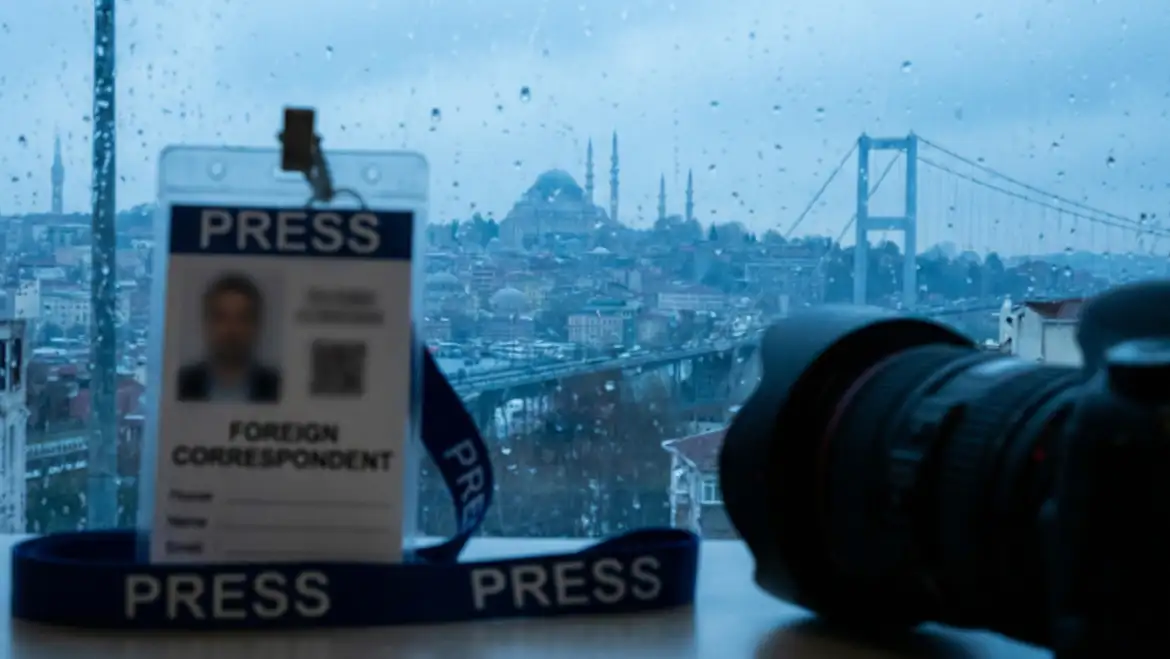
For a long time, there was an assumption among journalists working around Türkiye: if things became too difficult inside the country, there were still ways to operate safely, from abroad, through international networks, or simply by not being a Turkish citizen.
That assumption is starting to break.
In early 2026, reports surfaced about a Deutsche Welle journalist being detained. Around the same time, an exiled Iranian journalist in Türkiye faced the risk of deportation. These are not isolated events. They point to a broader shift.
The pressure on journalism is no longer confined to Turkish citizens. It is extending outward, toward foreign reporters and exiled voices who were once seen as outside the immediate reach of domestic enforcement.
A Changing Risk Landscape for Journalists
Following the aftermath of the cup attempt in 2016, most enforcement efforts focused inward. Turkish journalists, academics, and civil society actors were the primary targets.
That is still the case. But what has changed is the expanding spectrum.
Foreign journalists are now encountering situations that were once largely limited to domestic journalists: questioning, short-term detention, and administrative actions tied to their reporting work.
For exiled journalists, the situation can be even more fragile.Türkiye has often functioned as a transit or temporary base. Now, even that position can feel uncertain.
When Reporting Becomes Exposure
The issue is not that foreign journalists are committing crimes, but that their work intersects with areas considered politically sensitive—more precisely, issues that could fuel accountability efforts.
Covering political developments.
Speaking with sources under an arbitrary investigation.
Reporting on civil society or state actions.
These are standard aspects of journalism, but in certain contexts, especially under authoritarian policies and practices, they can be interpreted differently.
Considering the frequent mass arrests, enforcement patterns often focus on networks and associations, not just individual acts. For journalists, that creates a situation where simply doing their job can bring them into legal attention.
The Role of Detention
Detentions involving foreign journalists tend to be shorter and more controlled than long-term prosecutions. But that does not make them insignificant.
Even brief detention can:
Disrupt reporting
Send a message to other journalists
Create uncertainty around what is permitted
For international media organizations, these incidents are closely watched because they signal how the situation is evolving.
Deportation Is the Bigger Concern
While detention draws headlines, deportation carries deeper consequences.
For foreign journalists, deportation means removal from the country and loss of access. For exiled journalists, it can be far more serious.
In recent cases, deportation procedures have been linked to administrative decisions framed around security or public order. These decisions are not always transparent, and the legal process can be difficult to challenge quickly.
The key issue is not only being asked to leave. It is where the person is sent.
When Deportation Becomes Dangerous
For exiled journalists, returning to their country of origin may not be safe.
This is where international law becomes critical.
The principle of non-refoulement prohibits sending someone back to a place where they face serious risk. This applies especially to individuals who have already left their country due to persecution.
When an exiled journalist faces deportation, the question is not administrative. It is protective.
Will they be safe if they are sent back?
If the answer is uncertain, the situation becomes a human rights issue.
Legal Ambiguity and Limited Clarity
One of the challenges in these cases is the lack of clear, consistent information.
Foreign journalists may not always know:
What triggered the action
How long it will last
What their legal options are
Procedures can move quickly, especially in administrative contexts, and decisions may be made without detailed public explanation.
This creates a situation where journalists are navigating uncertainty rather than clear rules.
A Broader Pattern of Expansion
These developments do not exist on their own.
They connect to a wider pattern that has been evolving in Türkiye since 2016.
Large-scale dismissals, detailed in what is KHK in Turkey, reshaped public institutions. The long-term consequences of those decisions are explored further in life after KHK in Turkey.
At the same time, enforcement expanded through arrests, investigations, and administrative measures. The overall scale of this shift is documented in Turkey purge statistics.
What we are seeing now is an extension of that same system—applied in new directions.
Why This Matters for Press Freedom
Press freedom is not only about whether journalists can publish.
It is about whether they can:
- move freely
- speak to sources
- operate without fear of detention or removal
When foreign journalists begin to face these risks, it affects how international coverage of Türkiye is produced.
It can lead to:
- reduced on-the-ground reporting
- reliance on secondary sources
- hesitation in covering sensitive topics
Over time, this changes not only journalism, but also how the country is understood globally.
The Human Side of These Cases
Behind each case is a person navigating uncertainty.
A journalist unsure whether they can continue working.
An exiled writer wondering if they will be forced to return.
A family dealing with the possibility of sudden departure.
These situations are not always visible. They do not always result in long trials or public cases.
But they shape lives in quiet, immediate ways.
Why Silenced Turkey Tracks These Developments
Silenced Turkey focuses on patterns rather than isolated headlines.
By documenting cases involving journalists, civil society actors, and others, Advocates of Silenced Turkey builds a clearer picture of how enforcement evolves over time.
This includes:
- identifying trends across different groups
- connecting individual cases to broader systems
- providing context that helps explain not just what is happening, but why
That approach is essential for understanding changes that are gradual, but significant.
Conclusion
For foreign and exiled journalists, Türkiye is no longer a clearly defined space.
It is a place where the boundaries of safety are shifting.
Detention may be temporary.
Deportation may be administrative.
But the impact is real.
Understanding why foreign journalists are being arrested in Turkey is not just about individual cases. It is about how systems expand, how risks evolve, and how the environment for journalism changes over time.
Silenced Turkey exists to document that change with clarity and consistency.
Other Blog Posts
How Does the Rule of Law Erode? A Decade of Evidence From Turkey
Reading Systemic Human Rights Violations in Türkiye (2015–2025) No country becomes authoritarian overnight. No building collapses from a si...
Read More
The Right to a Defense, Denied: İmamoğlu’s July 2026 Hearings
The right to defend oneself is one of the foundations on which a fair trial rests. Without it, a courtroom risks ceasing to be a place where...
Read More
İmamoğlu on Trial: Anatomy of a 407-Defendant Mega-Case
In March 2025, the elected Mayor of Istanbul and Türkiye's leading opposition figure was detained, then jailed. One year later, his case ope...
Read More