How Does the Rule of Law Erode? A Decade of Evidence From Turkey
Reading Systemic Human Rights Violations in Türkiye (2015–2025)
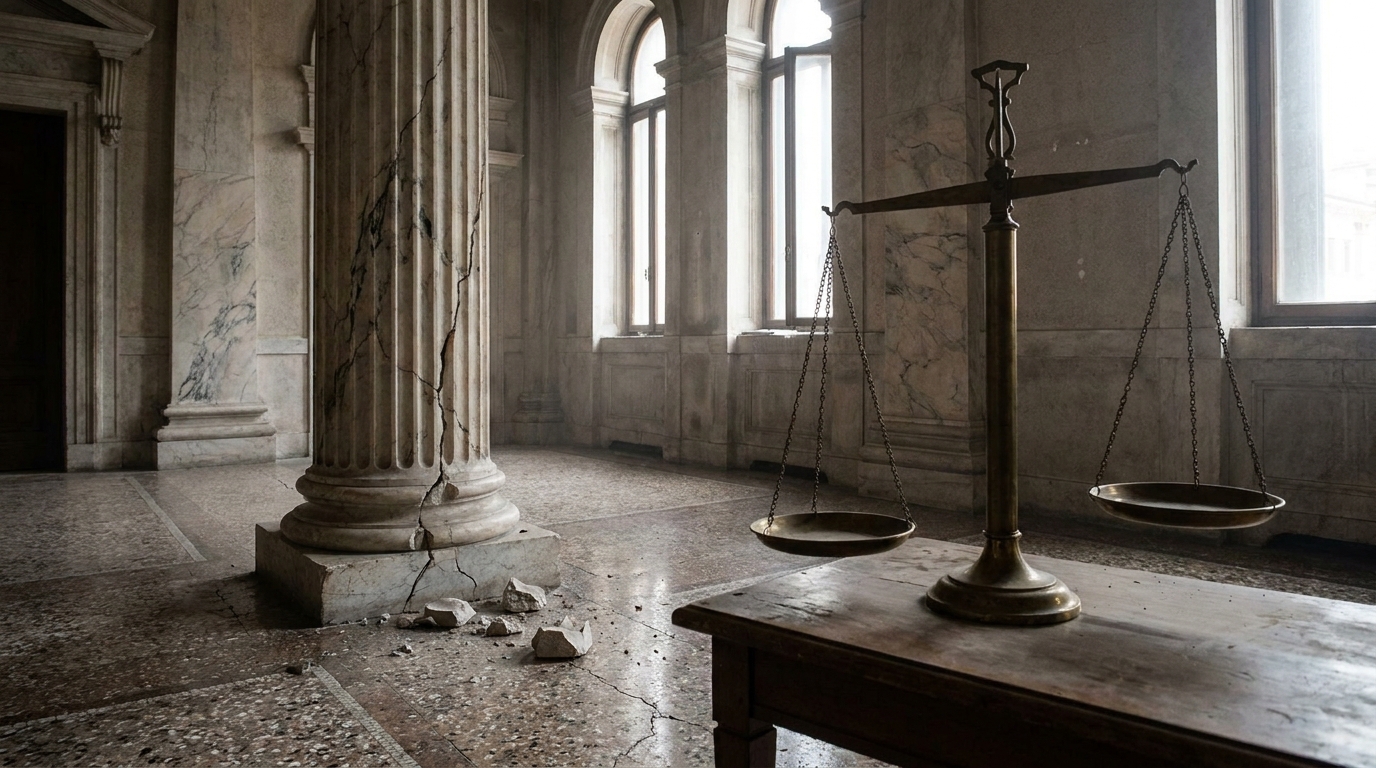
No country becomes authoritarian overnight. No building collapses from a single crack, and the rule of law does not collapse from a single coup, a single election, or a single court ruling.
What happens instead is slower. First the language of the law changes. Then the functioning of the courts. The media falls silent. Universities grow hesitant to think differently. Prisons expand. Passports are revoked. People begin to leave. Through all of it, life continues — people go to work, children go to school, television stations keep broadcasting. From the outside, everything looks normal. Yet the contract between the state and its citizens has quietly been rewritten.
That is precisely what makes authoritarianism dangerous. It builds itself through small acts of normalization.
A different kind of report
Look back over the past decade and you will find thousands of news reports on Turkey, hundreds of human rights reports, dozens of international assessments: judgments of the European Court of Human Rights, communications from United Nations Special Rapporteurs, the U.S. State Department’s annual human rights reports, Freedom House assessments, the World Justice Project’s Rule of Law Index, and countless studies by national and international civil society organizations.
Most of them showed one corner of the same picture.
Our new report Systemic Human Rights Violations in Türkiye (2015–2025), takes a different approach. It presents no new events and introduces no new witnesses. Instead, it gathers hundreds of reports published over the last decade — official statistics, international court judgments, and the findings of human rights organizations — into a single statistical map.
In that sense it is less a conventional human rights report than a reference work: an attempt to set out the political anatomy of Turkey’s last decade in one place.
The report opens with a clear proposition. Its authors argue that what happened between 2015 and 2025 should not be read as a series of isolated violations, but as a systematic model of repression that reshaped the legal system, the social order, and daily life. They point to the expansion of anti-terror legislation, to criminal investigations launched against millions of people, and to the dismantling — by emergency decree — of schools, media organizations, civil society groups, and healthcare institutions. That process, the report argues, also eroded economic confidence, social solidarity, and public trust in state institutions.
The scale, in numbers
The judicial statistics in the opening pages illustrate the scale of the transformation.
Drawing on data from Turkey’s Ministry of Justice, the report documents 3,979,733 criminal investigations launched between 2014 and 2024. In the same period, 3,810,769 individuals were officially registered as suspects, and 762,688 people received prison sentences. Article 314 of the Turkish Penal Code — “membership in an armed terrorist organization” — became one of the country’s most frequently applied criminal provisions, accounting for 2,303,967 investigations on its own.
The figures are remarkable in themselves. But the real question is a different one.
When millions of people are investigated under the same category of offense, does that indicate a rise in crime? Or has the definition of the crime itself changed?
The cornerstone of modern criminal law is individual criminal responsibility. People are prosecuted for their concrete actions, not their affiliations. In democratic legal systems, terrorism offenses are defined through objective elements: violence, coercion, participation in armed activity. The AST report argues that after 2016 the scope of Turkey’s anti-terror legislation expanded dramatically, and with it the country’s entire legal practice.
What is really at issue, then, is how the state defines its own citizens. Once a state begins to judge people less by what they have done than by the relationships they have kept, the line between law and security blurs.
Hannah Arendt’s observation on totalitarianism is difficult to avoid here. What defines such regimes, she argued, is not repression alone but the destruction of legal predictability. Once people can no longer foresee which of their actions may later be treated as criminal, fear stops being an individual emotion and becomes the climate of a society.
This is what gives the AST report its weight. It documents changes in legal language, and then makes their social consequences visible: passport cancellations, dismissals from public service, disputes over property, restrictions on education, limits on freedom of movement, social stigma. None of these, the report insists, are isolated developments. They are different faces of a single transformation.
Reading it, one question kept returning: once the language of law begins to change, where does it stop?
The answer lies in the pages that follow — where we encounter not only courts, but children, prisons, journalists, seriously ill inmates, and finally an entire society.
Begin with the children
If you want to understand the character of a legal system, look at how it treats the powerless. It is no accident that one of the report’s most striking chapters is about children.
In 2024 alone, 2,977 children were prosecuted on terrorism-related charges, and 1,051 were convicted. The age distribution is starker still: 1,218 children between the ages of 12 and 14 appeared before heavy criminal courts, while 9,761 children were tried before juvenile courts. In the same year, 22,416 children received prison sentences in juvenile courts.
The numbers speak for themselves. But the report does more than count. Through two investigations — one in Istanbul, one in Gaziantep — it shows how the concept of security has steadily widened. Among the activities cited in the indictments: studying the Qur’an, joining voluntary study groups, attending social events, going bowling with friends, taking part in the Erasmus exchange program, living in shared student apartments, keeping certain circles of friends. The report also cites a joint communication sent to Turkey by eight United Nations Special Rapporteurs.
The issue is not whether any single prosecution was justified. The issue is how far the idea of security has stretched. Once a state begins to see children as potential security threats, security itself loses its natural limits.
That is no longer only a question of children’s rights. It is a question about the rule of law.
Why torture is more than an individual violation
The report’s second major theme is torture and ill-treatment. According to the Human Rights Foundation of Turkey (TİHV), 6,249 people applied to the Foundation between 2016 and 2024 reporting torture or ill-treatment. In 2024 alone, 504 of 697 applicants said they had been tortured in official detention facilities, and 93.8 percent reported being subjected to more than one method. The most frequently reported practices were physical violence, insults, threats, forced confessions, deprivation of basic necessities, and psychological abuse.
The report adds an important caution: these are documented cases only. The real number is almost certainly higher, given fear of retaliation, lack of confidence in complaint mechanisms, and a widespread perception of impunity.
Seen politically, the target of torture is always broader than the person subjected to it. What is done to a handful of people becomes a silent message to millions. Torture is not only a violation of rights; it is a mechanism of fear that reshapes how a society behaves.
What prisons tell us
Dostoevsky’s line has rarely felt more apt: the degree of civilization in a society can be judged by entering its prisons.
Turkey’s prison population grew from roughly 177,000 inmates in 2015 to 433,547 by November 2025. Official capacity over the same period stood at 304,956 — an occupancy rate of 142 percent. Turkey now holds one of the largest prison populations in Europe.
The report’s argument, though, is not simply about size. It is about the quiet transformation of pretrial detention from an exceptional measure into ordinary judicial practice. Its graphs show pretrial detainees rising from roughly 15 percent of the prison population in 2015 to approximately 36 percent within a relatively short period.
That is a paradigm shift. In democratic legal systems, detention before trial exists to protect the judicial process, and nothing more. Over time, the report argues, it has increasingly become a punishment in itself.
Elderly and seriously ill prisoners
Among the report’s most difficult sections is the one on elderly and seriously ill prisoners. As of 2025, Turkish prisons hold 1,412 seriously ill prisoners, 5,864 elderly prisoners, and 269 prisoners with disabilities. The report examines delayed hospital transfers, medical examinations conducted while prisoners remain handcuffed, procedures before the Council of Forensic Medicine, and obstacles to treatment. It names prisoners who reportedly died after being denied adequate healthcare.
What is being debated here is a constitutional state’s philosophy of punishment. Is punishment the deprivation of liberty? Or has imprisonment become a status in which even the right to healthcare is suspended?
That question belongs to every state governed by the rule of law.
When journalists are silenced
The chapter on the media is no less troubling. 131 media outlets were closed by emergency decree. 567 journalists were imprisoned. 3,802 press cards were revoked. Access to 1,297,000 websites was blocked. Turkey’s position in the World Press Freedom Index fell from 138th in 2010 to 159th in 2025.
The rule of law is also an economic question
One of the report’s most revealing graphics is the World Justice Project’s Rule of Law Index, which shows Turkey declining after 2014 from 65th to 118th among 143 countries. Beside it sits a second graph, from Freedom House: a 28-point drop in Turkey’s freedom score in four years, placing the country in the “Not Free” category.
The closing pages assemble economic indicators — Turkey’s rise in global inflation rankings, the depreciation of the lira against the dollar, the collapse in the purchasing power of the 200-lira banknote, rising bread consumption.
The report does not claim that human rights violations caused Turkey’s economic crisis. It draws attention to a relationship. When institutional confidence erodes, when the rule of law weakens, when the judiciary stops being predictable, the economy does not stay untouched. The quality of rights, law, and democracy is also an economic question.
Europe’s mirror
One of the strongest chapters examines the case law of the European Court of Human Rights (ECtHR) concerning Turkey, moving the discussion from domestic politics into international law. The question becomes how far Turkey’s legal practice conforms to the standards of the European Convention on Human Rights, to which it is a party.
To date, the Court has issued 6,884 judgments finding violations against Turkey, with more than 21,000 applications still pending. No set of figures can settle the merits of individual cases. But Turkey’s consistent place among the Council of Europe member states with the most applications and the most findings of violation points to structural problems. The report treats these statistics as a mirror.
Particular attention goes to Article 7 of the Convention — no punishment without law. This principle guarantees that an act cannot be punished through interpretations developed after the fact if it was not criminal when committed. Legal certainty and foreseeability follow from it.
Within that frame, the report reads the cases of Yüksel Yalçınkaya, Karslı, Bozkuş, Demirhan, and others together, noting that the Court found Article 7 violations affecting 1,808 individuals. What links these judgments is a shared question about the foreseeability of criminal liability and the principle of legality. What is at stake is not a set of individual disputes but an international assessment of how one of criminal law’s most fundamental principles has been applied.
The Yalçınkaya judgment, and the line of cases that followed, is best understood as a mirror held up to Turkey’s criminal justice system by European human rights law.
The convergence
The report’s final argument concerns consistency. It reviews the U.S. State Department’s annual human rights reports from 2016 to 2024, sorting the findings on Turkey into 17 categories: judicial independence, arbitrary detention, political prisoners, torture and ill-treatment, prison conditions, restrictions on expression and the press, internet censorship, pressure on civil society, labor rights, corruption, women’s rights, child labor, and more.
What stands out is not any single allegation but the recurrence. The same concerns appear year after year, and in several areas continue to widen. These are not isolated crises but structural patterns.
The report then places Freedom House scores, the World Justice Project index, ECtHR judgments, UN Special Rapporteur communications, and other sources on a single timeline. These institutions differ in method, structure, and expertise — and yet their findings converge. Rule-of-law indicators decline. Freedom scores deteriorate. Press freedom weakens. Findings of violation multiply. Highly qualified people emigrate. Economic indicators worsen.
If all of this is happening in the same period, can it be explained as a set of unrelated phenomena?
The report’s contribution is not that it answers that question definitively, but that it shows why the question must now be taken seriously — by the lawyers, political scientists, and historians who will one day write the history of contemporary Turkey.
Other Blog Posts
The Right to a Defense, Denied: İmamoğlu’s July 2026 Hearings
The right to defend oneself is one of the foundations on which a fair trial rests. Without it, a courtroom risks ceasing to be a place where...
Read More
İmamoğlu on Trial: Anatomy of a 407-Defendant Mega-Case
In March 2025, the elected Mayor of Istanbul and Türkiye's leading opposition figure was detained, then jailed. One year later, his case ope...
Read More
Silencing the Press Before the Summit: Journalists Detained Ahead of NATO
When a government wants to control what the world sees, it starts with the people whose job is to report it. In the days before NATO's leade...
Read More