The İmamoğlu Trial Explained: 400 Defendants, 2,000 Years, and Turkey’s Opposition on Trial
Executive summary
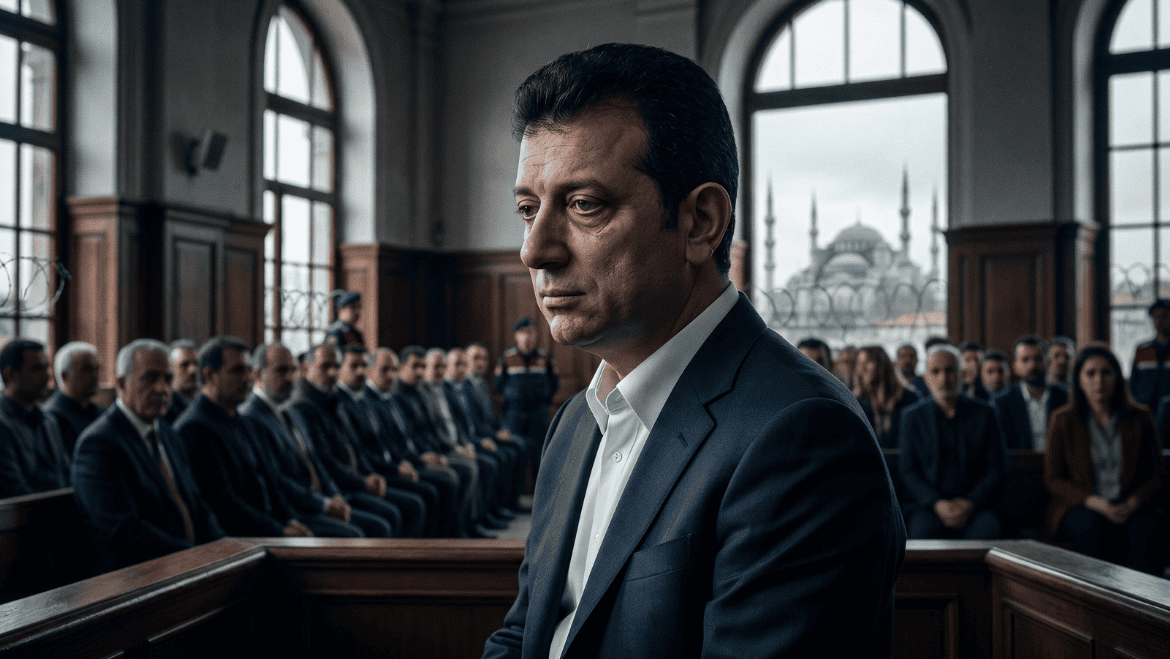
In March 2026, Ekrem İmamoğlu, the elected mayor of Istanbul and the Republican People’s Party (CHP) nominee for the Turkish presidency, went on trial alongside more than 400 co-defendants in a corruption case the prosecution describes as a 10-year, 142-act criminal enterprise. The combined charges, if all secured a maximum sentence, would expose İmamoğlu to a notional prison term exceeding 2,000 years. He has been in pretrial detention since March 23, 2025. Human Rights Watch, the European Parliament, the Council of Europe’s Parliamentary Assembly, and a long list of domestic and international observers have characterized the prosecution as politically motivated. This post walks through the timeline, the charges, the pattern, and what it tells us about the trajectory of opposition politics in Turkey.
Timeline of the case
| Date | Event |
| 2019 (March) | İmamoğlu wins Istanbul mayoral election for CHP — a generational opposition victory. The election is annulled. |
| 2019 (June) | İmamoğlu wins the rerun by a wider margin and takes office. |
| 2024 (March) | İmamoğlu wins re-election as Istanbul mayor with 51% of the vote. |
| 2025 (March 19) | Detained by Turkish police on suspicion of corruption, extortion, bribery, money laundering, espionage, and “supporting terrorism” (PKK-related allegation). |
| 2025 (March 23) | Formally arrested pending trial — the same morning the CHP nominates him as its presidential candidate. |
| 2025 (April 14) | Turkish court rejects his appeal seeking release. |
| 2025 (October 27) | Additional charge filed: “political espionage.” |
| 2025 (November) | Indictment finalized: 142 alleged criminal acts over 10 years; 400+ co-defendants. |
| 2026 (March 3) | Trial opens in Istanbul before more than 400 defendants. |
This is one of the largest corruption-style trials in modern Turkish history by defendant count, comparable in scale only to the post-2016 KCK and Ergenekon-era mass prosecutions.
What the indictment alleges
The November 2025 indictment frames İmamoğlu as the alleged leader of a criminal organization that committed 18 distinct corruption offenses across 142 acts, with the stated motive of “winning political power.” The charges include:
- Corruption and aggravated bribery
- Extortion
- Money laundering
- Bid-rigging at municipal-tendering bodies
- Aggravated fraud against public institutions
- “Political espionage” (added in late 2025)
- “Supporting a terrorist organization” (the prosecution alleges PKK-related links)
A central evidentiary thread relies on the testimony of cooperators (defendants who have entered into agreements with prosecutors). Defense lawyers have argued at length that those statements are internally inconsistent, coerced, or both. As of trial opening, no public-domain document corroborates the central conspiracy allegation independent of cooperator testimony.
Why human-rights organizations call this political
Human Rights Watch published its assessment on March 3, 2026, the day the trial opened. The headline was unambiguous: “Türkiye: Leading Opponent of Erdoğan on Trial.” HRW’s analysis identifies four characteristics that, in combination, distinguish a legitimate corruption prosecution from a politically motivated one:
- Prosecutorial timing tracks political timing. İmamoğlu’s arrest fell on the morning his party nominated him for the presidency. Pre-2025, several smaller prosecutions had been initiated against him after each electoral milestone: 2019, 2022, 2024.
- Asymmetry in scope. The indictment alleges a 10-year corruption enterprise but is built almost entirely from acts during İmamoğlu’s mayoral terms. Comparable scrutiny has not been applied to peer institutions held by ruling-coalition parties.
- Charges proliferate after detention. Espionage charges were not in the original detention order; they were added eight months in. This pattern, the addition of new charges during detention, has become a recurring feature of Turkey’s most criticized political prosecutions, including those of Selahattin Demirtaş and Osman Kavala.
- Prosecutorial reliance on cooperators. When the central case depends on the testimony of co-defendants who can shorten their own sentences by cooperating, the procedural risk of false statements increases sharply. International observers have flagged this specifically.
It is important to be precise: human-rights organizations have not asserted that all 400+ defendants are innocent of every act alleged. The argument is that the use of prosecution regarding its timing, scope, and the “leader of a criminal organization” framing applied to an opposition presidential candidate is what marks it as a political trial, regardless of whether individual procurement decisions did or did not cross legal lines.
The pattern: prosecuting elected opposition figures
The İmamoğlu prosecution is not isolated. Since 2016, Turkey has cumulatively imprisoned, removed from office, or replaced with state-appointed trustees a long list of elected opposition figures, particularly from the pro-Kurdish HDP/DEM Party tradition. Among the most prominent:
- Selahattin Demirtaş, former HDP co-chair, has been in prison since November 4, 2016. The European Court of Human Rights has ruled (twice) that his detention violates the European Convention. He remains imprisoned.
- Figen Yüksekdağ, former HDP co-chair, has also been detained since November 2016, on similar charges and similar ECHR findings.
- Dozens of HDP/DEM Party mayors were replaced by government-appointed trustees (“kayyum”) after their elections in southeastern provinces.
The İmamoğlu case is novel only in that the defendant is from the secular center-left CHP rather than the Kurdish-rights parties that have absorbed most of this pressure since 2016. That broadening of scope from Kurdish opposition to mainstream secular opposition is one of the characteristic developments of 2025–26.
What conviction would mean
A conviction on the headline charge of “leading an organized criminal enterprise” would result in immediate disqualification from holding public office. Turkey’s electoral law bars individuals convicted of certain categories of offense (including “supporting terrorism” and aggravated corruption) from running for any elected position. A convicted İmamoğlu would be barred from running for president, which, given that he was the CHP’s nominee, would effectively eliminate the most credible electoral challenge to the ruling AKP MHP coalition in the next election cycle.
That outcome is not hypothetical. Similar precedents already exist. Demirtaş’s conviction prevented his return to political life, while the disqualification of dozens of HDP mayors produced the same effect at the municipal level.
What’s happening to the protests
İmamoğlu’s March 2025 detention triggered the largest urban protests Turkey has seen since the 2013 Gezi demonstrations. The state response has been instructive:
- Mass arrests of protesters, with thousands detained in the first 30 days alone.
- Internet throttling of major platforms during the peak protest window.
- Prosecution of journalists covering the protests, including the four reporters held in remand in March 2026 (Akgül, Kılıç, Kuray, Tosun).
- Travel bans issued against student-organizers, civil-society staff, and lawyers offering pro bono representation.
Each of those responses is itself the subject of separate AST reporting. The trial is the visible center of a much wider state operation.
Procedural status as of late April 2026
As of this writing:
- İmamoğlu remains in pretrial detention at Silivri.
- The trial is expected to last months, possibly years. Mass-defendant cases of this size routinely run for 18–36 months at trial, plus appeals.
- His legal team has filed multiple applications to the Constitutional Court of Turkey and to the European Court of Human Rights.
- The European Court has indicated it will fast-track examination of any application concerning his pretrial detention.
- A wide international monitoring presence, including diplomats, parliamentary observers, and human-rights NGOs, has attended each public hearing date.
What advocacy networks are asking for
Three asks consistent across HRW, the European Parliament’s rapporteur, and the Council of Europe:
- Immediate release pending trial. Pretrial detention for periods exceeding the maximum permitted by domestic and ECHR standards.
- Severance of the cases. A prosecution combining 400+ defendants and 18 distinct alleged offenses cannot give individual defendants meaningful access to a fair process.
- Independent monitoring of the proceedings. Council of Europe institutions and OSCE/ODIHR have offered to send official trial monitors. Acceptance of those monitors is a baseline procedural request.
Why this matters beyond Turkey
The İmamoğlu trial is the case international democracy-watchers will use as a benchmark for Turkey’s 2028 election cycle. If the trial concludes in a conviction that disqualifies him from running, the outcome will set a template both for the Turkish ruling coalition and for governments elsewhere observing what does and does not produce sustained international pushback.
The advocacy work happening over the next 18–24 months around this trial is therefore not just about one mayor. It is about whether the international system that Turkey is a part of, such as the Council of Europe, ECHR, EU candidacy framework, still has the institutional weight to influence how a major member state treats its political opposition.
That is the question AST and its partner organizations are pressing on, case by case, judgment by judgment.
────────────────────────────────────────
Sources: Human Rights Watch, “Türkiye: Leading Opponent of Erdoğan on Trial” (March 3, 2026); HRW, “Türkiye: Court Jails Istanbul Mayor” (March 24, 2025); Al Jazeera, “Turkish court orders Istanbul mayor jailed pending trial” (March 23, 2025); Al Jazeera, “Turkiye court charges jailed opposition leader with ‘political espionage'” (October 27, 2025); ABC News and Washington Times reporting on trial opening (March 2026); Wikipedia, “Arrest of Ekrem İmamoğlu” (consolidated timeline).
Other Blog Posts

How Does the Rule of Law Erode? A Decade of Evidence From Turkey
Reading Systemic Human Rights Violations in Türkiye (2015–2025) No country becomes authoritarian overnight. No building collapses from a si...
Read More
The Right to a Defense, Denied: İmamoğlu’s July 2026 Hearings
The right to defend oneself is one of the foundations on which a fair trial rests. Without it, a courtroom risks ceasing to be a place where...
Read More
İmamoğlu on Trial: Anatomy of a 407-Defendant Mega-Case
In March 2025, the elected Mayor of Istanbul and Türkiye's leading opposition figure was detained, then jailed. One year later, his case ope...
Read More