Turkey Falls to 163rd in 2026 World Press Freedom Index: Inside the RSF Report
Executive summary
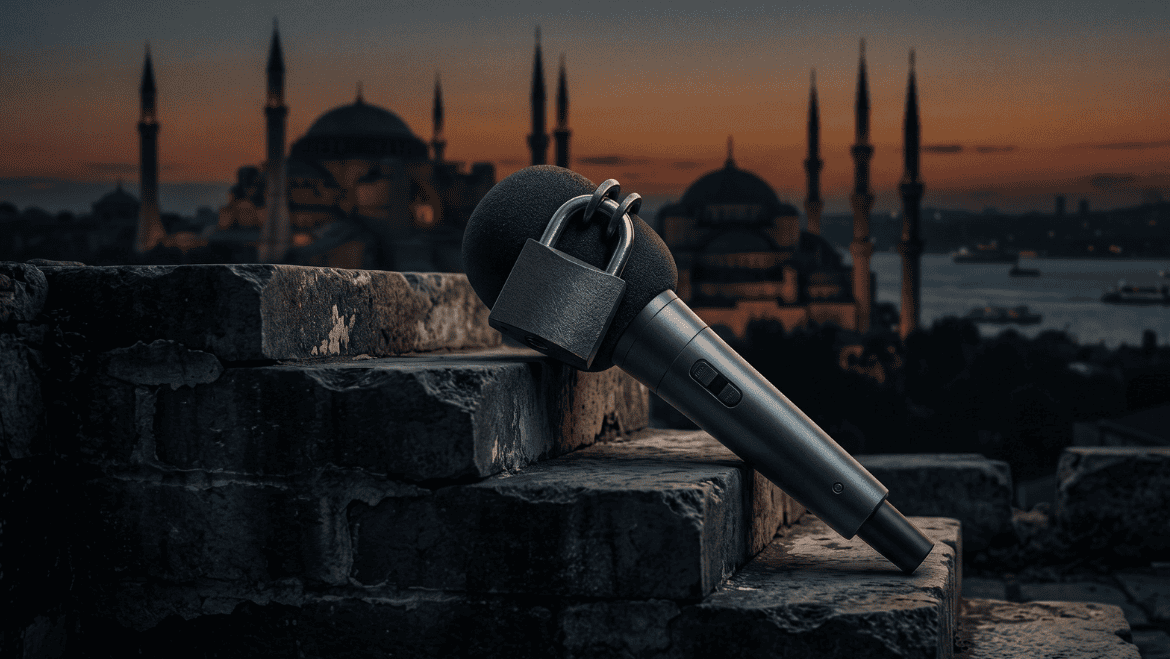
Reporters Without Borders (RSF) published its 2026 World Press Freedom Index on April 30, 2026, and the global picture is the worst it has been in the 25 years RSF has measured it. Turkey now ranks 163rd of 180 countries — a four-place fall from 159th in 2025 — placing it among the bottom 10% of states for press freedom worldwide. The drop tracks with what AST has documented on the ground over the past year: the pretrial detention of working reporters, the prosecution of foreign correspondents, and the use of “spreading misleading information” charges to silence newsroom investigations. This post walks through the four indicators the RSF Index measures, explains where Turkey scored lowest, and names the journalists whose recent arrests anchored the country’s decline.
What the RSF Index measures (and why a 4-place drop matters)
The Press Freedom Index scores each of 180 countries across five indicators: political, economic, legislative, social, and security. A country’s overall ranking is built from those scores; a fall of even one or two places usually reflects a measurable change on at least one indicator.
A four-place fall from 159th to 163rd is therefore not noise. It signals that on at least one indicator, Turkey’s press environment got materially worse over the previous year. RSF’s own commentary on the 2026 release pinpoints judicial harassment of journalists and economic pressure on independent outlets as the principal drivers, both areas where Turkey’s score deteriorated.
For context, a country at 163 sits below states like the Democratic Republic of Congo and Tajikistan. The Index does not weight all rankings the same; the difference between, say, 12th and 18th is small, but the difference between 159th and 163rd is the difference between “highly restricted” and “essentially captured.”
What changed in Turkey in the year measured
The 2026 RSF Index covers reporting incidents from roughly March 2025 through February 2026. Inside that window, Turkey accumulated a record of newsroom-facing prosecutions that no other Council of Europe member state matched.
Among the most-cited cases:
- Ismail Ari, a reporter for the opposition daily Birgün, was placed in pretrial detention on March 22, 2026 on a charge of “spreading misleading information.” Ari had previously won the Uğur Mumcu Investigative Journalism Award. Press-freedom advocates noted that nothing in the indictment alleged anything other than journalism.
- Yasin Akgül, Bülent Kılıç, Zeynep Kuray, and Ali Onur Tosun, four photojournalists and reporters, were arrested in March 2026 on charges of “participation in unauthorized demonstrations” while covering protests sparked by the detention of Istanbul Mayor Ekrem İmamoğlu. They were held in remand until their release on March 27, 2026. RSF called the decisions “arbitrary.”
- Fatih Altaylı, a veteran journalist who had moved his work to YouTube, was sentenced on November 26, 2025 to four years and two months in prison for what the court characterized as a threat against President Recep Tayyip Erdoğan during a livestream. Press-freedom organizations and defense lawyers have characterized the comments as protected political commentary.
- At the time of Human Rights Watch’s most recent country writeup, 27 journalists and media workers were in pretrial detention or serving sentences in Turkey.
These are not the only cases, they are the publicly named ones. RSF’s full Turkey dossier lists prosecutions targeting smaller outlets, regional reporters, and freelance contributors who are far less visible to international observers.
How “fake news” laws became prosecutorial templates
Three legal provisions are doing most of the work in 2026:
- Article 217/A of the Turkish Penal Code (disseminating misleading information): added in October 2022. It carries a penalty of up to three years in prison for publishing information deemed by prosecutors to threaten public order.
- Article 299 (insulting the President): Prosecutions under Article 299 have grown roughly tenfold since 2014. Conviction can produce up to four years’ imprisonment.
- Anti-terrorism laws (Law No. 3713): used to recharacterize editorial decisions as material support for outlawed organizations, particularly when reporting touches on Kurdish-rights coverage.
The pattern these statutes share is breadth. Prosecutors do not have to demonstrate knowledge of falsity, intent to harm, or threat of imminent violence. They have only to convince a court, frequently the same kinds of courts that have been the subject of repeated European Court of Human Rights findings, that the speech in question fits inside the statute’s elastic boundary.
What this means for the AST audience
AST has documented individual cases, including students, lawyers, civil-society staff, foreign reporters. The 2026 RSF Index is the macro number that those individual cases sum to. When a country falls four places in a global press-freedom index, what that captures, mathematically, is that the rate at which journalists are being prosecuted and the rate at which independent outlets are being economically squeezed has both accelerated.
For policymakers, that is the headline: Turkey’s press-freedom environment is not stable. It is deteriorating measurably and predictably.
For diaspora communities and former reporters now publishing from outside Turkey, the Index is also a warning. RSF’s commentary on the 2026 release noted a continuing pattern of pressure on exile media, including denial of broadcast licenses, banking-relationship terminations, and platform takedown requests, that follows journalists across borders.
What advocacy looks like from here
Three specific, evidence-based asks have emerged from press-freedom organizations responding to the 2026 Index:
- Repeal Article 217/A. The “disseminating misleading information” statute is the single fastest-growing source of journalist prosecutions in 2025–26. Council of Europe institutions, the EU Parliament’s rapporteur on Turkey, and several UN special rapporteurs have called for its repeal or substantial narrowing.
- Implement the European Court of Human Rights’ free-expression judgments. As of early 2026, the ECHR has issued 432 rulings since 2002 finding Turkey in violation of Article 10 (freedom of expression). Implementation is the legally required next step, it is not optional under the European Convention.
- End pretrial detention for journalists charged with speech offenses. Pretrial detention is supposed to be a last resort; in Turkey it has become a default for working reporters. The Council of Europe’s Parliamentary Assembly has highlighted this specific abuse repeatedly.
These are not matters of opinion; they are grounded in agreements Turkey has already signed and rulings it is legally obligated to follow.
How to support the journalists named in this report
AST works to surface specific cases that risk being lost in aggregated statistics. Readers who want to act on this 2026 Index can:
- Share the names Ari, Akgül, Kılıç, Kuray, Tosun, and Altaylı when discussing Turkey’s press freedom decline. Specificity drives policy.
- Support legal-defense funds for accredited Turkish press organizations.
- Write to elected representatives about Article 217/A and Article 299 prosecutions.
- Subscribe to AST’s mailing list for the next case-by-case update.
Press freedom in Turkey is not declining because the world has run out of attention. It is declining because the legal and institutional mechanisms used to suppress journalism have advanced faster than the international response. The 2026 RSF Index makes that gap measurable. Closing it is precisely what AST and its partners are working to achieve.
────────────────────────────────────────
Sources: Reporters Without Borders 2026 World Press Freedom Index (April 30, 2026); RSF country file on Türkiye; Human Rights Watch World Report 2026 — Türkiye chapter; Al Jazeera, “Press freedom worldwide falls to its lowest level in 25 years” (April 30, 2026); Turkish Minute reporting on individual journalist cases.
Other Blog Posts
How Does the Rule of Law Erode? A Decade of Evidence From Turkey
Reading Systemic Human Rights Violations in Türkiye (2015–2025) No country becomes authoritarian overnight. No building collapses from a si...
Read More
The Right to a Defense, Denied: İmamoğlu’s July 2026 Hearings
The right to defend oneself is one of the foundations on which a fair trial rests. Without it, a courtroom risks ceasing to be a place where...
Read More
İmamoğlu on Trial: Anatomy of a 407-Defendant Mega-Case
In March 2025, the elected Mayor of Istanbul and Türkiye's leading opposition figure was detained, then jailed. One year later, his case ope...
Read More