Inside Türkiye’s Nationwide Arrest Operations: Who Is Being Targeted and Why?
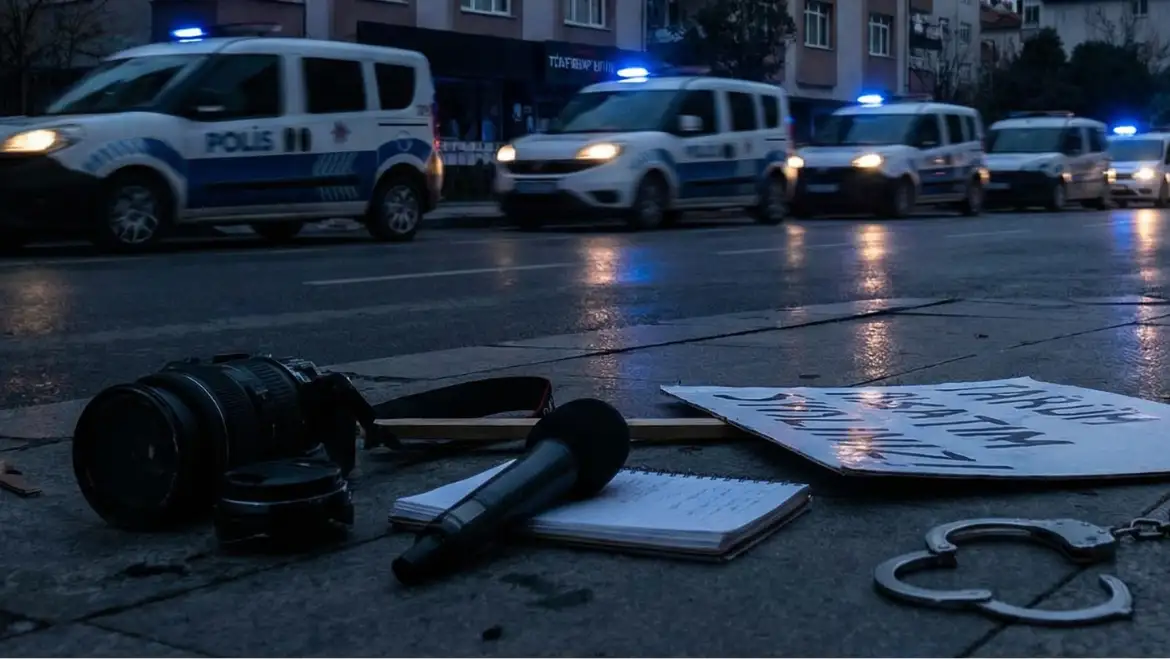
In February 2026, coordinated police operations took place across Türkiye.
Early morning raids were carried out in 22 different cities. Doors were broken open before sunrise. Homes were searched. Devices were confiscated.
By the end of the operation, at least 96 people had been detained.
They were not armed groups.
They were not engaged in violence.
They included journalists, youth organizers, union members, and civil society actors.
For many observers, the scale of the operation raised a familiar question:
Is this about security — or about control?
A Pattern, Not a One-Time Event
The February 2026 operation did not happen in isolation.
Since 2016, Türkiye has developed a recognizable pattern of mass arrest operations carried out simultaneously across multiple cities. These operations are typically:
- Coordinated at the national level
- Conducted during early morning hours
- Targeting groups connected by profession, ideology, or association
- Framed under anti-terror or national security laws
According to documentation and pattern analysis by Advocates of Silenced Turkey (AST), these operations are not random. They follow a repeatable structure, often expanding the scope of who can be targeted.
Who Is Being Detained in 2026?
The February 2026 arrests offer a clear snapshot of current targeting trends.
Those detained included:
- Journalists reporting on political or social issues
- Youth group members involved in civic organization
- Union representatives advocating for labor rights
- Individuals connected to NGOs or community initiatives
What connects these groups is not criminal activity.
It is visibility, organization, and influence.
These are individuals who operate in spaces that shape public opinion, social coordination, or collective action.
Why Multi-City Operations Matter
Mass arrests across multiple cities send a different message than isolated detentions.
They demonstrate:
- Coordination
- Scale
- Reach
When arrests happen in 20+ cities simultaneously, it signals that enforcement is not local — it is systemic.
This has two major effects:
- It disrupts networks nationwide, not just individuals
- It creates a psychological impact far beyond those detained
The message becomes clear:
no region is outside the scope of enforcement
The Legal Basis: Broad Anti-Terror Frameworks
Most mass arrest operations in Türkiye are justified under anti-terror laws.
These laws allow authorities to detain individuals based on:
- Alleged organizational affiliation
- Communication patterns
- Participation in certain activities
- Indirect or associative evidence
The challenge lies in how broadly these criteria are applied.
In many cases, activities that would be considered civil or professional in other contexts are reinterpreted as indicators of affiliation.
This legal flexibility makes it possible to carry out large-scale operations affecting diverse groups.
From Individuals to Networks
Unlike traditional criminal investigations, mass arrest operations often focus on networks rather than acts.
Authorities may target:
- Entire professional circles
- Groups linked by association
- Individuals connected through events or organizations
This approach shifts the focus from:
👉 “What did this person do?”
to
👉 “Who is this person connected to?”
From a legal perspective, this raises concerns about individualized evidence and responsibility.
The Human Impact of Coordinated Raids
Behind the numbers are lived experiences that follow a consistent pattern.
Individuals detained in mass operations often describe:
- Being taken from their homes in early morning hours
- Limited access to legal counsel during initial detention
- Public exposure through media coverage before formal charges
- Uncertainty about the duration and outcome of detention
For families, the impact is immediate:
- Sudden absence of a parent or provider
- Lack of information in the first critical hours
- Long-term legal and financial stress
These are not isolated incidents. They are repeated across operations and years.
Connection to the Post-2016 System
Mass arrest operations are part of a broader post-2016 framework in Türkiye.
Since the so-called coup attempt:
- Hundreds of thousands of people have been detained or investigated
- Over 162,000 public servants were dismissed through emergency decrees
- Anti-terror laws have been applied across a wide range of cases
The February 2026 operation reflects a continuation of this system — not a departure from it.
According to AST’s ongoing documentation, the tools developed during the state of emergency have evolved into long-term mechanisms.
Why Journalists and Activists Are Central Targets
The inclusion of journalists, activists, and union leaders in recent operations is significant.
These groups play key roles in:
- Information dissemination
- Public accountability
- Collective organization
Targeting them affects not only individuals, but also the flow of information and civic participation.
When journalists are detained, reporting is reduced.
When activists are detained, organizing is disrupted.
When unions are targeted, collective bargaining weakens.
The impact extends beyond legal outcomes — it reshapes the public space.
International Perspective
Mass arrest operations in Türkiye have drawn increasing attention from international observers.
The key concerns are not limited to numbers. They focus on:
- Proportionality of enforcement
- Use of pre-trial detention
- Breadth of anti-terror definitions
- Impact on civil society
For human rights organizations and legal analysts, these operations are evaluated as part of a systemic pattern, rather than isolated law enforcement actions.
Why These Operations Are Difficult to Track
One of the challenges in understanding mass arrests in Türkiye is the lack of a centralized, transparent dataset.
Information is often fragmented:
- Official statements provide limited detail
- Media coverage varies in depth and accuracy
- Legal outcomes may take years to clarify
This is where independent documentation becomes essential.
AST compiles:
- Case data
- Timeline tracking
- Pattern analysis
- Cross-referenced reporting
This allows for a clearer picture of how mass arrest operations evolve over time.
Why Silenced Turkey Documents These Patterns
Silenced Turkey does not focus on single events.
It focuses on patterns that repeat.
By documenting operations like the February 2026 arrests alongside earlier cases, AST provides:
- Context
- Continuity
- Comparability
This transforms isolated incidents into evidence of systemic behavior.
For researchers, journalists, and legal professionals, this type of documentation is critical.
Conclusion
Mass arrests across multiple cities are not just law enforcement actions.
They are signals.
They show how power is exercised, how networks are disrupted, and how the boundaries of enforcement are defined.
The February 2026 operation — with 96 people detained across 22 cities — is not an exception.
It is part of a continuing pattern.
Understanding Turkey mass arrests in 2026 means looking beyond the headlines and examining how these operations function, who they affect, and why they continue.
Silenced Turkey exists to document that reality — not moment by moment, but pattern by pattern.
Other Blog Posts

How Does the Rule of Law Erode? A Decade of Evidence From Turkey
Reading Systemic Human Rights Violations in Türkiye (2015–2025) No country becomes authoritarian overnight. No building collapses from a si...
Read More
The Right to a Defense, Denied: İmamoğlu’s July 2026 Hearings
The right to defend oneself is one of the foundations on which a fair trial rests. Without it, a courtroom risks ceasing to be a place where...
Read More
İmamoğlu on Trial: Anatomy of a 407-Defendant Mega-Case
In March 2025, the elected Mayor of Istanbul and Türkiye's leading opposition figure was detained, then jailed. One year later, his case ope...
Read More